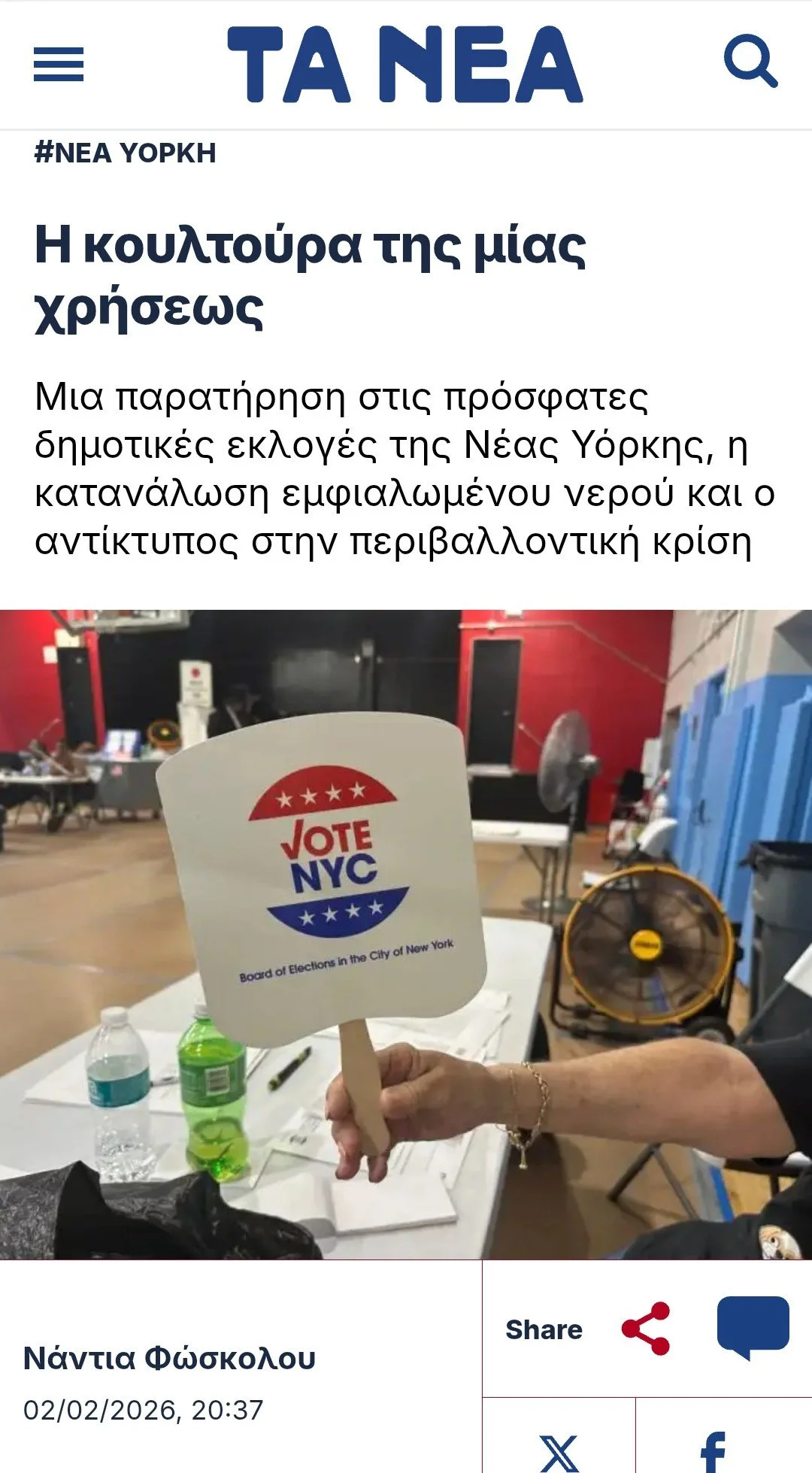
The scene is at this past November's NYC mayoral election: outside the voting center, a table has been set up where free sweet treats (individually wrapped candy of the worst possible type) are given away to voters, as well as small disposable water bottles, in spite of the fact that we are at a public school, and the water fountain is steps away. I observe the four-year-old boy of a fellow-citizen couple, and I'm musing on what kind of a lesson this “desk full of goodies” teaches him: 1) that when we vote, we are rewarded with free candy; and 2) that when we are thirsty, we pick up a little plastic bottle to drink water.
I will bypass the very deep philosophical question of whether there should be immediate material reward (ok, treat) because someone exercised their voting right, or whether the teaching should be moral satisfaction, and therefore purposely the act should not be accompanied by snacks, to underline its ideological dimension – exercising one's right to vote belongs to the Realm of Ideas; why mix it up with Mars and M&M's?
I won't even dwell on the fact that the treat of choice was the worst form of processed sugar – whoever conceived the endeavor could have at least seized the opportunity and tried to give some type of healthy nutrition lesson to the diabetes- and obesity-stricken Harlem, by offering, say, a fruit, in a neighborhood where the population practically lives on fried chicken.
But I simply cannot let go of the free bottled water, when right nearby flows abundantly the renowned tap water of New York City, one of the cleanest and best-tasting in all America.
Science and stage in collaboration
The notion of “behavior change” comes to my mind. It was one of the fundamental takeaways at the Science & Stage Collaborative Fellowship, which I was fortunate enough to complete in 2016 in NYC. Six fellows – three carefully selected climate scientists, who were also skilled in theatre, and three theatre artists – exchanged expertise, techniques and philosophies over the course of four months. The experiment culminated in the performance of an original short theatre piece, created and performed by us six, in front of a live audience. As is often the case, experiential learning proved superb: no matter how many books and articles on the topic of the environment I may read, what I learned then and there from my scientist classmates – a Ministry of Agriculture researcher sings about the transgenic products; a PhD in Marine Biology turns her research on Florida turtles into a choreography – I will never forget.
So, the notion of “behavior change” had been of intense focus within that fellowship. It is one of the hard but so evident truths that emerge as a solution to the environmental problems we are facing. Numerous are the behavior changes that just “happen” – that happen to us – they go hand in hand with what we call “life.” We change, or are forced to change, to adjust our behavior, countless times: because of age, health, work, for love, for a friend, for any kind of relationship. So many are the changes that most of the time we don't even realize we are changing our behavior – and we consider this absolutely natural.
The taboo
Yet, there is one type of behavior change toward which the general attitude is systematically to hide – no one dares call things by their real names: choosing, when faced with an issue of environmental color, an action that appears “ascetic,” old-fashioned, hard. This type of behavior change is taboo. It is a taboo to discuss the option of shifting towards a more planet-friendly behavior, which requires discipline and determination and, yes, perhaps even sacrifice. This is the bitter truth that no one dares face, let alone touch upon.
Going back to the original scene with the free plastic water bottles, this setup would have made a great opportunity for someone (the City of New York, the government, some administrative entity) to encourage us to proceed to a change of behavior: to not consume yet another disposable bottle and instead to carry with us a refillable one, since the tap with the magnificent drinking water is in front of our eyes.
“I forgot” is the standard argument, followed by “It's not convenient,” “I don't feel like carrying it around,” and so on.
Try not to forget it. Try to remember it. Train yourself to remember it. Learn from the following example: “I've left my phone at home, and I have to survive a whole day without it! Pure tragedy – I'll never allow myself to forget it, ever again.” Why is it that in other fields the notion of behavior change is not even brought up? Why is it that in other cases no one reacts with “I forgot,” “It's not convenient” etc? I am referring to those behavior changes that involve new consumption habits, and for which we all appear super prepared. Behavior changes that pertain to consuming are massively promoted in such a meticulous and systematic way that we have been convinced they are normal, natural, even good, before we even adopt them.
“And we sucked it up,” as the song goes
It was fun, and, I too, like most us, was full of curiosity and excitement when I acquired my first mobile phone in the late '90s. However, if someone were to tell me that, a few years later, I would be carrying around everywhere and at all times, awake or asleep, a device that does not simply cost hundreds of dollars, but also contains my whole life (from personal photos to my tax return), and that I would consider this “normal” - well, that I never suspected, and chances are I would not have believed it, back in 1997, if a little bird from the future had come and sung it to me.
Why is smartphone-living considered normal, and carrying your own water bottle eccentric? Hell, because we have been trained to consider the former good and right, and the latter odd! We are (or seem to be) ready to embrace any massively propagated kind of behavior change because special campaigns convince us, train us; because we are creatures of imitation; because we try to follow every trend, anything new, out of fear of being characterized as backward-thinking, dumb, not up-to-date, technologically antique, etc.
Disposable culture
At that fellowship I also learned that in America, at the dawn of the Age of Plastic, it took special campaigns to convince, to train people NOT to reuse the objects of the Brave New Disposable World. That era is not that distant, and yet we behave as if the world had been like that – single-use – since the dawn of time.
I was a child in the '70s and '80s, and I myself remember how the small plastic water bottle came into our lives – it wasn't there since the beginning of time. Let alone my parents' generation, who, when they were outside and got very thirsty, would walk into a diner or café and kindly ask for a glass of water. This mass hysteria over consuming a plastic bottle at the drop of a hat is not that old.
The habit of disposability ends up creating a culture of disposability, which naturally extends not only to objects and goods but to almost everything. If the idea of the expendable dominates one field of our life and behavior, then how do you keep it under control so that it doesn't spill elsewhere as well?
This essay first appeared in Greek in the TA NEA newspaper (online) on February 2, 2026.
It was reproduced by HellasJournal.com.
Το κείμενο αυτό πρωτοδημοσιεύτηκε στην εφημερίδα TA NEA (ηλεκτρονική έκδοση) στις 2 Φεβρουαρίου 2026.
Αναδημοσιεύτηκε από το HellasJournal.com.
Για να διαβάσετε το ελληνικό κείμενο, κάντε κλικ εδώ.